

Can a Luxury Tent Survive Heavy Rain, Wind, and Tropical Storms?
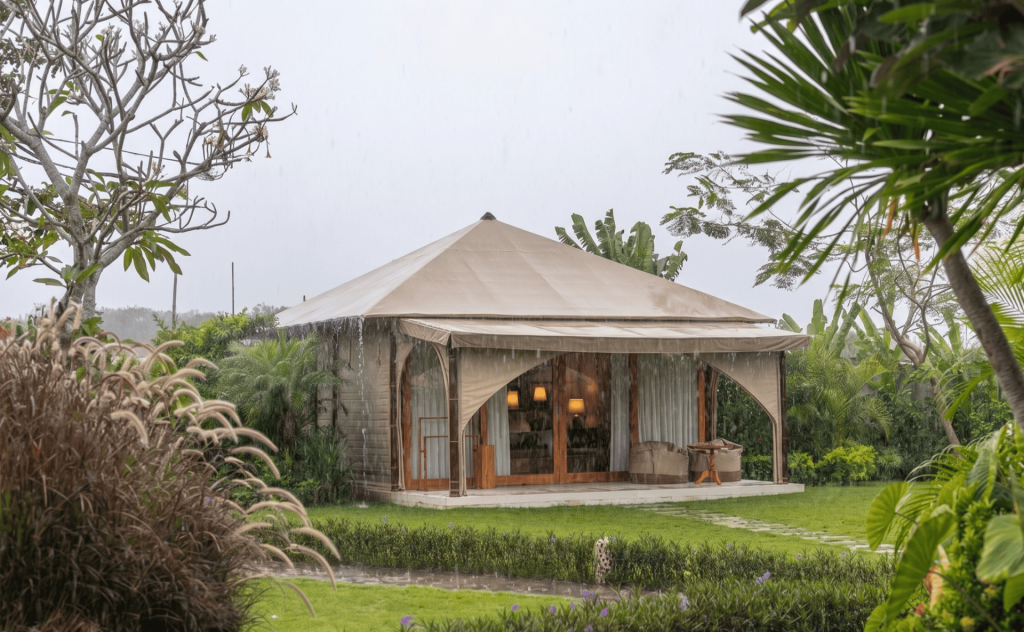
It is the question every investor asks before the question about design. Before finishes, before furniture, before the pool placement — can the structure actually take what the climate is going to throw at it? Here is the honest, technical answer.
Ask anyone considering a glamping resort in Bali, Costa Rica, Northern Australia, or the Philippines what keeps them up at night, and it is rarely the interior mood board. It is the wet season. Monsoon rain that does not let up for days. Gusts strong enough to strip a roof. The word “storm” is attached to a region that also happens to have the best land, the best views, and the best guest demand.
The short answer is yes — a luxury tent can absolutely survive heavy rain, high wind, and tropical storm conditions. But that answer only holds if the structure was engineered for it from the first specification conversation, not patched for it afterward. Here is what actually separates a canvas structure that holds up from one that does not.
| MONSOON RAIN: Drainage, roof performance | SUSTAINED WIND: Structural frame stability | STORM GUST: Joints, anchoring, uplift resistance | WHAT’S TESTED: Frame, Canvas, Drainage, Anchoring |
Why Tropical Sites Ask More of a Structure
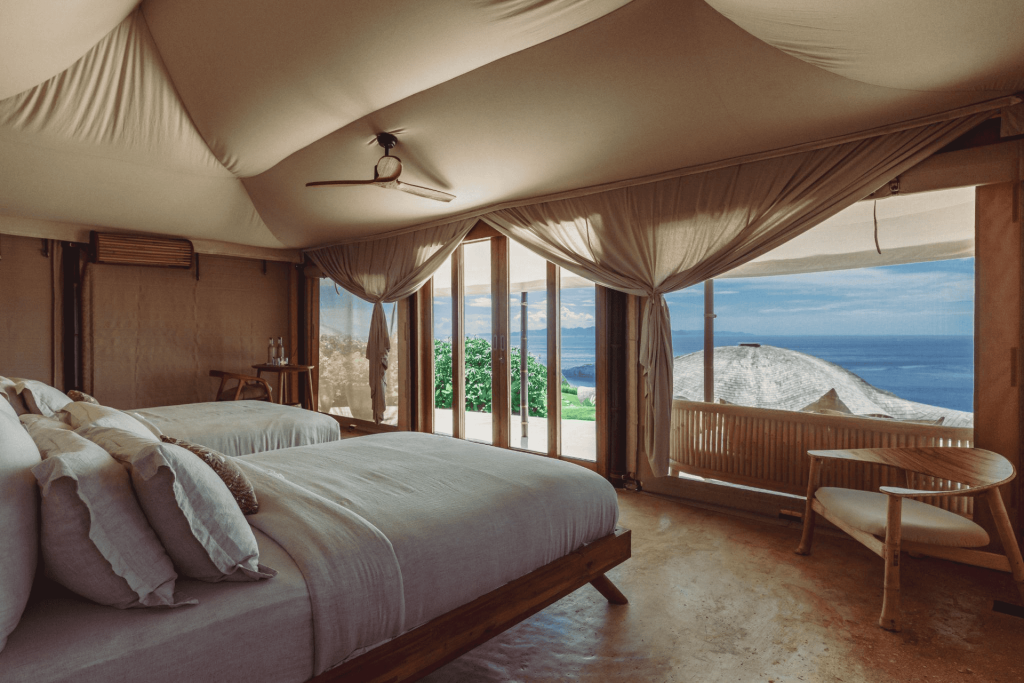
A temperate-climate glamping site deals with occasional rain and moderate wind. A tropical site deals with something structurally different: rainfall measured in hundreds of millimetres over a few hours, humidity that never really drops, and wind events that arrive fast and leave just as fast. Coastal and forested tropical sites — exactly the sites developers want, for exactly the reasons guests want them — are also the sites most exposed to seasonal storm systems.
This is not a reason to avoid canvas architecture in the tropics. It is a reason to be precise about how it is built. The tents already operating successfully through Bali’s wet season, Qatar’s shamal winds, and coastal Central America’s storm months are not surviving by luck. They are surviving because four systems were engineered to work together: the frame, the roof, the canvas, and the ground connection.
The Frame: Where Wind Resistance Actually Starts
Wind does not fail a tent at the fabric first. It fails at the frame, at the joints, and at the anchoring — the places most invisible to a guest and most critical to an engineer. A structure rated for tropical storm exposure starts with a galvanised steel frame engineered against a specific wind load, not a generic “outdoor rated” spec pulled from a catalogue.
That means:
- Load calculations matched to the site, not a standard template — a beachfront plot in a typhoon corridor and a sheltered valley three kilometres inland do not carry the same wind exposure, and the frame specification should reflect that difference.
- Reinforced joints and bracing at every connection point, since a frame is only as strong as its weakest joint.
- Anchoring into the client’s foundation, engineered to resist uplift as much as lateral force — wind does not just push a structure sideways; it tries to lift the roof.
None of this is visible once the villa is finished. It is, however, the single biggest factor in whether a tent is still standing after the first real storm of the season.
The Roof: Pitch, Drainage, and Overhang
Rain does not damage a well-built canvas roof through the fabric — it damages a structure through pooling, backflow, and water finding the one seam that was not sealed properly. Three design decisions determine whether a tropical roof performs or struggles:
Roof pitch. A steeper pitch sheds water fast, before it has time to pool or find weakness in a seam. The same geometry that sheds snow load in a mountain climate sheds monsoon rainfall in a tropical one — the engineering logic is identical even though the climates look nothing alike.
Extended eaves. Deep overhangs keep driven rain away from the wall base and the foundation line, which matters enormously in a storm where rain rarely falls straight down. Wind pushes it sideways, and an eave that stops short leaves the wall system exposed exactly where it is most vulnerable.
Continuous drainage detailing. Gutters, downpipes, and ground-level drainage are sized for tropical rainfall volumes — not just for a light shower — so water is carried away from the structure rather than allowed to sit against it.
The Canvas: A Layered System, Not a Single Fabric
The word “tent” undersells what is actually a multi-layer building envelope. A canvas structure engineered for tropical storm exposure typically carries:
- An exterior weatherproof, UV-resistant fabric — the layer that faces sun, driven rain, and wind abrasion, day after day, season after season.
- A waterproof canvas underlay beneath it seals the structure against wind-driven rain that gets past the outer layer.
- An insulation core, which does double duty in the tropics — keeping interior heat stable and adding structural rigidity to the whole roof assembly.
- A fire-retardant interior ceiling and wall finish, the layer guests actually see, is unaffected by whatever the outer layers are managing above and around it.
The strength of this system is not any single layer — it is that each layer has one job, and none of them is asked to do more than that job. A tropical storm tests all four at once, which is exactly why all four need to be specified correctly from the start.
Wind and Water: What “Storm-Ready” Actually Means in Numbers
Developers are right to ask for numbers, not adjectives. “Storm-resistant” means little without a wind rating attached. When we scope a tropical project, the conversation covers:
| Standard Tropical Site: Moderate seasonal wind, heavy monsoon rain | Coastal / Exposed Site Sustained higher wind, storm surge proximity | Typhoon / Cyclone Corridor Extreme wind events, engineered for regional code |
Each tier changes the frame specification, the anchoring depth, and sometimes the roof geometry itself. This is also why a site assessment always comes before a design proposal — a villa specified for a sheltered forest plot in Bali is not the same structure as one specified for an exposed beachfront in a cyclone-prone province, even if the finished interiors look identical to a guest.
What Guests Never See — and Never Should
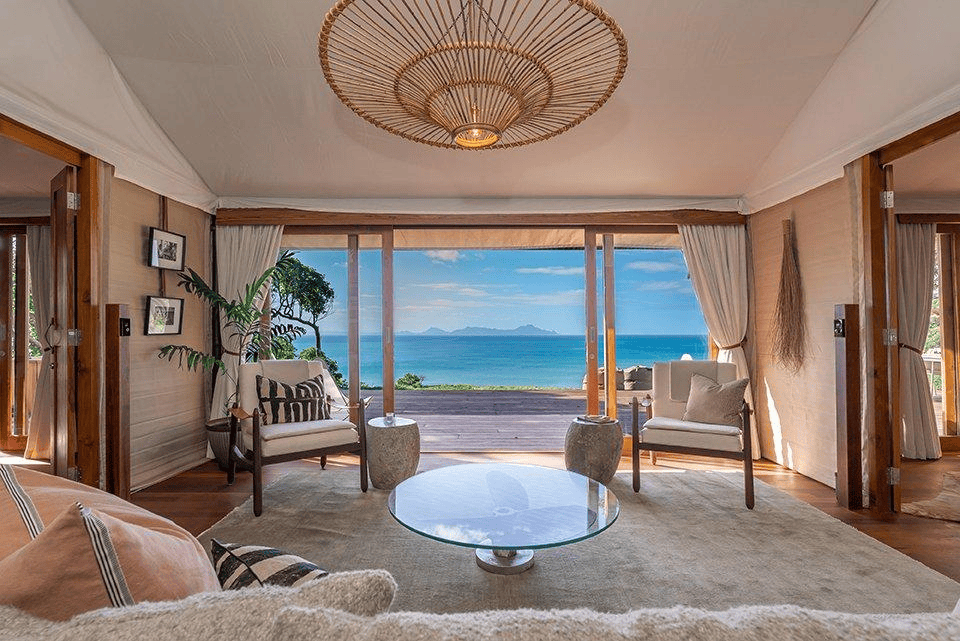
The entire point of engineering a tent for tropical storm exposure is that guests should never think about it. A well-built villa performs quietly: the roof sheds, the walls hold, the bathroom stays dry, and the only sign of the storm outside is the sound of rain on canvas — which, done properly, becomes part of the experience rather than a liability.
A luxury tent that cannot survive the climate it is built is not a luxury tent. It is a beautiful structure with a very short lifespan.
This is also where the enclosed, weather-sealed bathroom matters as much in the tropics as it does in a snow-bound mountain villa. A private bathroom with properly sealed canvas walls and correct drainage is not a comfort detail — it is a test of whether the wall system actually works under sustained wet-season conditions.
Wet Season and Dry Season: Two Very Different Performance Tests
A tropical resort is not judged by one season — it operates through both, and each one stresses a different part of the structure.
| 🌧️WET SEASON: Monsoon rainfall, high humidity, occasional storm systems. Tests drainage, waterproofing, and wind anchoring. | ☀️DRY SEASON: Intense UV, heat, and dust. Tests fabric UV-resistance and interior cooling from the insulation core. |
A structure engineered only for the dry season’s good weather — the version most guests picture when they imagine glamping — will struggle the first time the sky actually delivers on its reputation. A structure engineered for both is the one that keeps operating and keeps its resale and lifespan value, year after year.
The Real Question for Investors
The question is rarely whether canvas architecture can survive heavy rain, wind, and tropical storms. It can — the physics and the engineering are well understood, and tented structures already operate successfully in some of the world’s most demanding climates, from desert shamal winds to alpine snow loads. The real question for anyone developing in a tropical region is whether the structure in front of them was actually specified for their site or specified for a brochure photo taken on a calm, sunny day.
That distinction is decided at the very beginning — in the site assessment and the specification conversation — long before the first frame goes up. Get it right there, and the storm season becomes a non-event. Get it wrong, and no amount of interior finish will make up for it.
Considering a Tropical Development?
Every exceptional structure begins with understanding the land it stands on. Before a single frame is specified, we study your site’s wind exposure, rainfall patterns, and environmental conditions — because true craftsmanship anticipates what a climate will demand, not just what it looks like on a calm day.
Let us understand what your vision requires.