

When the Brief Says Every Season. No Exceptions.
Most glamping developments are built for the good months. Keikoku Glamping Tent was built for all of them — including the ones where the forest disappears under snow.
Hinohara Village sits in the forested hills of western Tokyo, quiet, largely untouched, and subject to the kind of mountain climate that asks a lot of any structure. Snow in winter, high humidity through summer, the full transition between them. When the client brought us this site, the task was simple: keep it open all year, and make it excellent in every season.
That brief led us to deploy our Luxury Snow Tented Villa, a canvas architecture system designed from the ground up for exactly this kind of four-season environment. Here is how we approached it.
| SITE Forest Valley, Hinohara, Tokyo | CLIMATE 4-Season Mountain | STRUCTURES 2 Snow Tented Villas | OPERATION Year-Round |
Why a Snow Tent — and Not a Standard Villa
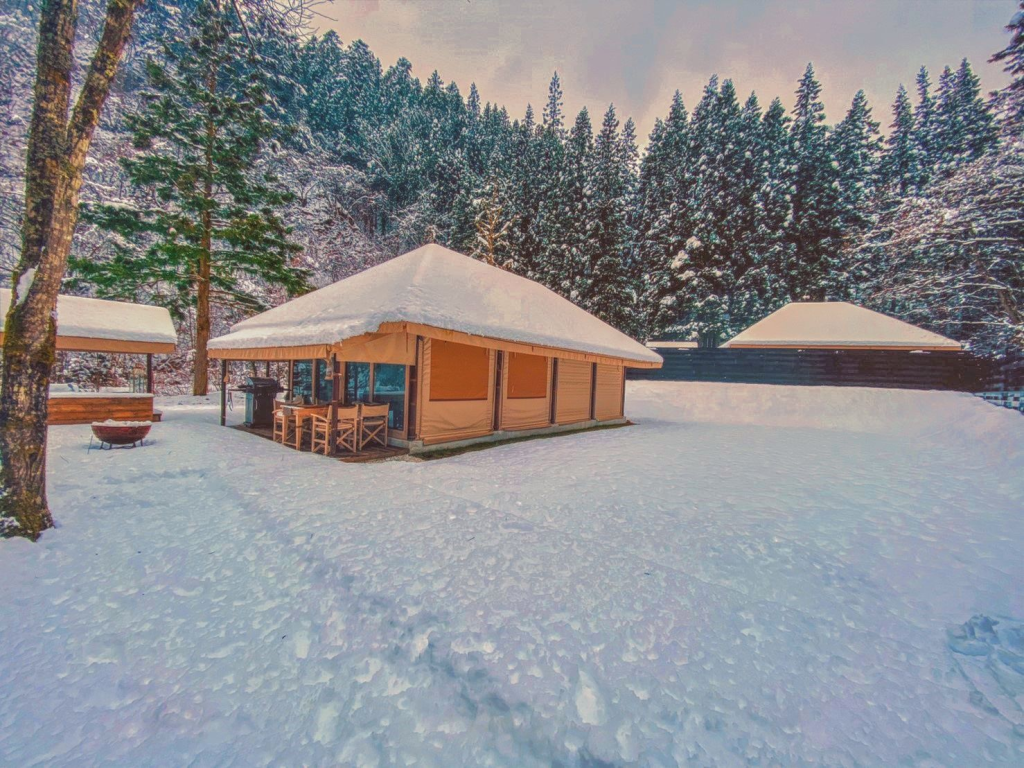
This is the first question we ask on any mountain project in Japan. A standard tented villa is built for most climates but not for a site where heavy snow is a seasonal given. The Snow Tent is different in the ways that matter: the roof sits at a steeper angle, so snow slides off rather than builds up. The eaves extend further, protecting the base of the walls from snowmelt and driven rain. The steel frame underneath is engineered to carry the additional load that winter brings.
None of this is visible to guests. What they notice is that the villa works — warmly, quietly, without drama — even when everything outside is white.
Built to Perform in Every Season
What makes a canvas villa truly all-season is not one clever detail, it is a layered system of materials working together. At Keikoku, the roof uses four distinct layers: a weatherproof, UV-resistant exterior fabric that handles sun, rain, and wind year after year; a waterproof canvas layer beneath it that stays effective from the coldest winter temperatures to the heat of a Japanese summer; an insulation core that keeps the interior stable regardless of what is happening outside; and a clean, fire-retardant interior ceiling that is what guests actually see and feel.
The walls follow the same logic, exterior weatherproofing, a soundproof insulation layer, and a warm interior finish. Together, the roof and wall systems mean the villa breathes like a canvas structure should, while holding heat like a well-built room.
One Detail That Changes Everything: the Enclosed Bathroom
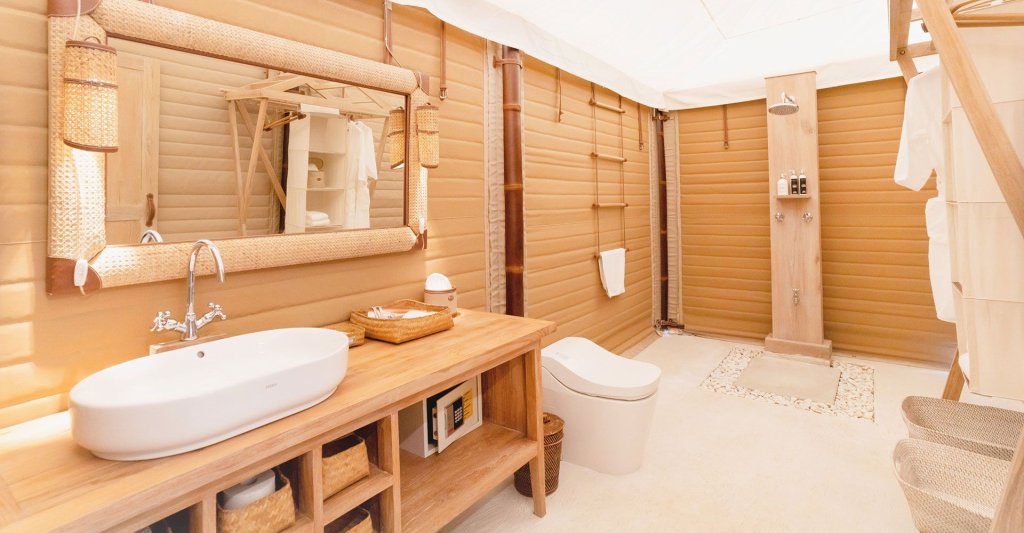
One of the things that separates a luxury canvas villa from a premium tent is the bathroom. At Keikoku, both villas have a fully enclosed private bathroom, built with roll-down insulated canvas walls that are weather-tight and thermally sealed. It functions exactly as a permanent bathroom should: private, warm, and properly finished, inside a structure made of canvas, in a mountain environment that drops below freezing in winter.
It is the kind of detail that guests do not consciously notice — because it just works. And that is precisely the point.
How We Build It
Our work begins once the client’s foundation is ready. From that point, everything above it — the structure, the insulation, the canvas, the interior — is ours to deliver. It follows a clear sequence, and the order matters: each stage creates the conditions the next one depends on.
| 1 Structure Installation The galvanised steel frame anchored to the client’s foundation — engineered for snow and wind loads. | 2 Decking Installation Wooden decking connecting indoor and outdoor living areas of the villa. |
| 3 Insulation Panel Installation EPS sandwich panels fixed to the roof frame — the thermal core keeping the interior stable across all seasons. | 4 Canvas Underlay Installation Waterproof canvas underlay applied over insulation — sealing against rain, snowmelt, and moisture. |
| 5 Exterior Canvas Installation Outer weatherproof canvas stretched and fixed — UV-resistant, self-cleaning, the face the world sees. | 6 Wall Panel Installation Insulated Signature Wall Panels throughout — weatherproofing, insulation, and interior finish in one system. |
| 7 Interior Fit-Out Doors, windows, bathroom enclosure, and all interior finishes installed — the villa becomes a liveable space. | 8 Final Finishing & Handover Furniture and accessories placed. Quality checked across every element before handing keys to the client. |
The Two Villas at Keikoku
Both structures share the same Snow Tent build standard. What differs is the footprint and the outdoor experience each plot supports.
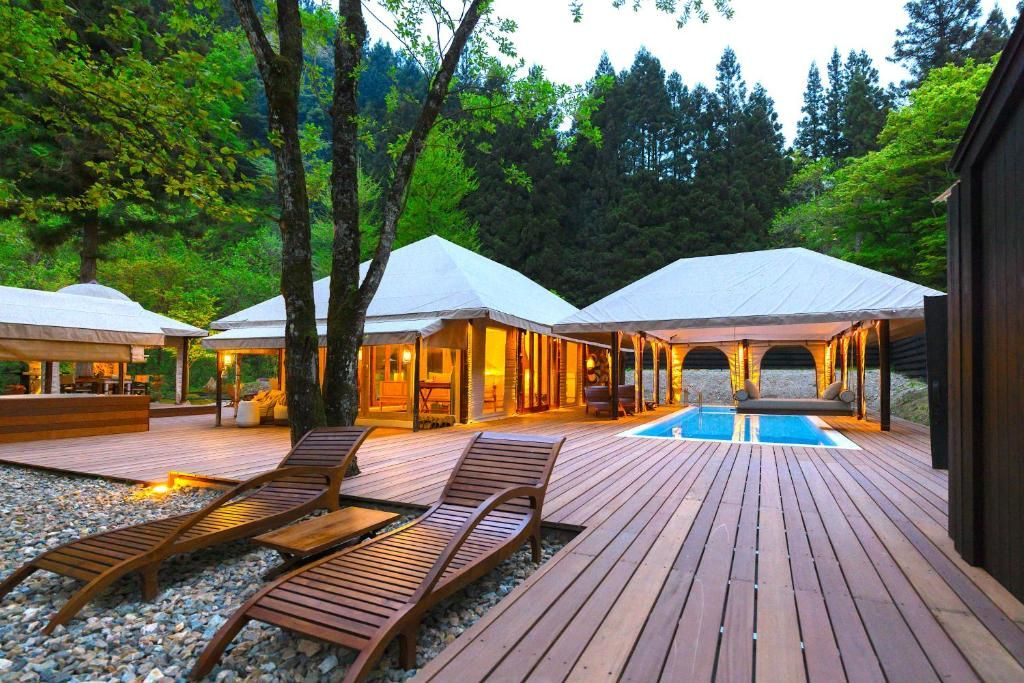
| VILLA ONE Suite Tent SIZE 50 sqm (5m × 10m) BEDROOM 1 master bedroom BATHROOM Fully enclosed, private OUTDOOR 3×10m pool, sauna, bonfire | VILLA TWO Luxury Tent SIZE 37.5 sqm (5m × 7.5m) BEDROOM 1 master bedroom BATHROOM Fully enclosed, private OUTDOOR Private sauna, bonfire |
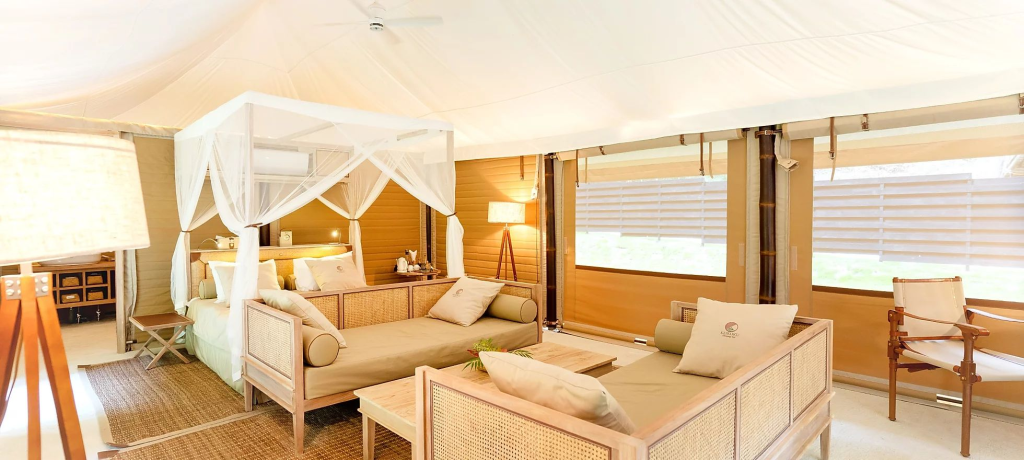
Both villas are fitted with sliding glass doors and privacy curtains, a roll-down projector screen that doubles as an extra insulation layer when closed, and a furniture palette of white-washed Balinese teak, leather and wood desk and chair, and Japanese decorative touches. Outside, our Signature Swing Canopy and a jacuzzi with tented canopy extend the outdoor living space across all seasons — not just the warm ones.
| All-season capability is not something you add at the end. It is decided in the first specification conversation — or it does not exist at all. |
What Each Season Looks Like at Keikoku
| 🌿SPRING The forest comes back green. Breathable canvas walls manage the rising humidity naturally. | ☀️SUMMER The insulation core keeps the interior cool even under heavy sun. The pool earns its place. | 🍂AUTUMN Warm amber tones across the valley. The sauna becomes the centre of the day as temperatures fall. | ❄️WINTER Snow on the hills, warm inside. The roof sheds, the walls hold, the villa stays fully open. |
Winter deserves a moment. It is the season that most clearly demonstrates what a Snow Tented Villa is built for. When the Hinohara hills are white and the river is cold and still, both villas at Keikoku remain fully open and genuinely warm. The sauna is at its best. The bonfire feels essential. And the contrast between the quiet, snow-covered forest outside and the lit, comfortable interior within is something guests remember long after they leave.
That experience does not happen by accident. It is the result of choosing the right structure for the climate and building it properly, from the ground up.Keikoku has since been featured in CLASSY and Tokyo Weekender. More than the recognition, it stands as a working example of what year-round canvas architecture can achieve when the brief, the site, and the build are genuinely aligned.
Have a site that needs to work all year?
We’d love to talk about what an all-season tented villa could look like for your project — wherever it is in the world.